Showing posts with label lead. Show all posts

Monday, February 17, 2014

Chapters 9 & 10


Chapter 9 - What Dies Inside

(sorry, forgot to take a picture of the finished book)


Encyclopedia volume, gesso, lead, wire, porcelain
Blind embossing
9.5" x 13.25" x 7.5"

Death is not the most painful loss in life. The most painful loss is what dies inside us while we're still alive.

Quote by Nishan Panwar


Chapter 10 - The Biggest Loss 


9.5" x 13.25" x 1"
Encyclopedia volume, gesso, lead, photographs
Blind embossing, transfers

One psychological element has been established beyond reasonable doubt, and that is the concept of loss. Loss in all of its manifestations is the touchstone of depression. In the progress of the disease and, most likely, in its origin.

Passage from Darkness Visible by William Styron. I can really relate to this passage; for me loss of control and loss of myself were the biggest and most devastating elements of my illness.


Sunday, February 16, 2014

Chapters 4, 5 and 6


Chapter 4 - Loneliness


Encyclopedia volume, gesso, lead, lead type
Blind embossed
9.5" x 12.75" x 2.5"

There is the solitude of suffering, when you go through darkness that is lonely, intense, and terrible. Words become powerless to express your pain, what others hear from your words is so distant and different from what you are actually suffering.


Chapter 5 - The Body Knows


Encyclopedia volume, gesso, lead, metal paint, bandages
Blind embossed
9.5" x 13" x 1.5"

DEPRESSION - one word to describe a mountain of pain. One word to steal the light from a person's soul and leave them stranded in a cold, gray landscape, alone and searching for something they couldn't even name. -Unknown


Chapter 6 - Hopelessness


Encyclopedia volume, gesso, card board, text
Hand stamped text
9.5" x 13.25" x 2"

In depression this faith in deliverance, in ultimate restoration, is absent. The pain is unrelenting, and what makes the condition intolerable is the foreknowledge that no remedy will come- not in a day, an hour, a month, or a minute. If there is mild relief, one knows that it is only temporary; more pain will follow. It is hopelessness even more than pain that crushes the soul.

Quote by William Clark Styron, Jr. (June 11, 1925 – November 1, 2006), an American novelist and essayist who won major literary awards for his work. In 1985, he suffered his most serious bout with depression. Out of this grave and menacing experience, he was later able to write the memoir Darkness Visible (1990), the work Styron became best known for during the last two decades of his life.


Wednesday, January 29, 2014

Primo Levi

I have loved and worked with lead for a long time now. I love its qualities of softness, malleability, color, its low melting point and the "mood" it exudes.

Primo Levi, the Italian Jewish chemist and writer, wrote the unique work, The Periodic Table (1975), linked to qualities of the elements, which the Royal Institution of Great Britain named the best science book ever written.

His essay on lead has always moved me, and I find it particularly appropriate to my project.

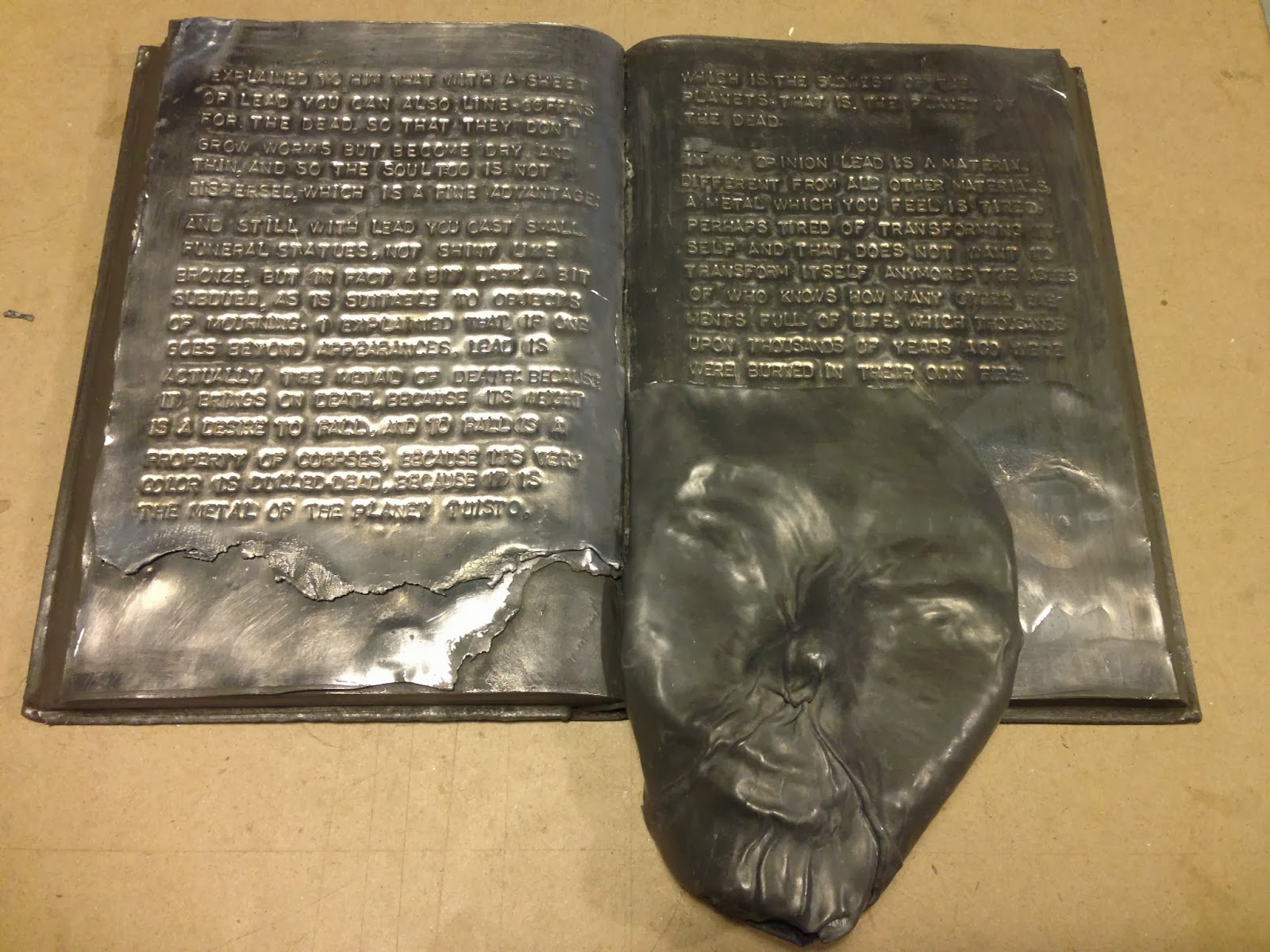
"There and then I found a hammer and a curbstone and showed him how easy it is to fashion it into slabs and sheets; then I explained to him that with the sheets, welding them on one side with a red-hot iron, you could make pipes.  I told him that wooden pipes for example, the rain pipes in that town Sales, leak and rot; I explained to him that bronze pipes are hard to make and when they are used for drinking water cause stomach trouble, and that instead lead pipes last forever and can be joined together very easily. Putting on a solemn face, I also took a random shot and explained to him that with a sheet of lead you can also line coffins for the dead, so that they don't grow worms but become dry and thin, and so the soul too is not dispersed, which is a fine advantage; and still with lead you can cast small funeral statues, not shiny like bronze, but in fact a bit dark, a bit subdued, as is suitable to objects of mourning. 

Since I saw that these matters interested him greatly, I explained that, if one goes beyond appearances, lead is actually the metal of death: because it brings on death, because its weight is a desire to fall, and to fall is a property of corpses, because its very color is dulled-dead, because it is the metal of the planet Tuisto, which is the slowest of the planets, that is, the planet of the dead. I also told him that in my opinion, lead is a material different from all other materials, a metal which you feel is tired, perhaps tired of transforming itself and that does not want to transform itself anymore: the ashes of who knows how many other elements full of life, which thousands upon thousands of years ago were burned in their own fire. 

These are things I really think; it is not that I invented them to close the deal.  That man, whose name was Borvio, listened to all this with his mouth agape, and then he told me that it really must be as I said, and that that planet is sacred to a god who in his town was called Saturn and is depicted with a scythe."


Monday, January 27, 2014

Slow . . .

There is slow stitching, which seems to be making a return these days, but there is also SLOW PRINTING . . .


I wanted to print text on a sheet of lead, and used my die tool to do so. But in order to get nice straight lines, I had to build a jig first.


It was worth the effort:


Tomorrow the page will be finished and I will post a better picture of it.